Equation of Motion
The equation of motion is a balance of three forces (click on them
for more details):
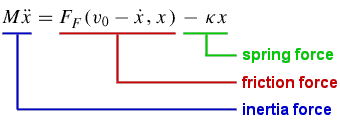
The inertia force is the
mass of slider M times its acceleration, i.e., the
second derivative of the slider position x(t)
as a function of time t.
The spring force
is caused by stretching or compressing the spring.
The force is proportional to the amount of stretching.
This is called the Hooke's law. The proportionality factor
is the so-called spring constant
 (the greek letter kappa).
In the animation the spring force is shown as a green arrow.
(the greek letter kappa).
In the animation the spring force is shown as a green arrow.
The friction force
is caused by the interaction between the slider and the surface
of the conveyor belt (moving with the constant velocity
v0). In the animation this force is shown by a
red arrow. In addition a red bar shows the dissipated energy
per time unit.
In general this is a function of many variables:
The relative sliding velocity  , the position, the force, the history etc.
The complexity of the interaction between the surface of two
sliding bodies is the central subject of the Friction Lab.
For the animation two functions, i.e.
friction laws, have been
choosen: Coulomb's law
and viscous friction.
The dynamics in the case of a generalized Coulomb's law is
investigated in a paper
(PDF 107Kb) I
published 1997.
, the position, the force, the history etc.
The complexity of the interaction between the surface of two
sliding bodies is the central subject of the Friction Lab.
For the animation two functions, i.e.
friction laws, have been
choosen: Coulomb's law
and viscous friction.
The dynamics in the case of a generalized Coulomb's law is
investigated in a paper
(PDF 107Kb) I
published 1997.
Without any friction we get the equation of motion of a
so-called harmonic oscillator. The motion of the slider
becomes a sinusoidal oscillation with a constant amplitude.
The period T of oscillation is independent of the oscillation
amplitude. It is determined by the mass and the spring constant:
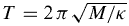
In the animation you get this motion when all friction parameters
(mu_s and mu_k in the case of Coulomb's law or
gamma in the case of viscous friction) are set to zero.
The Friction Lab© 2001, e-mail:
Franz-Josef doht Elmer aht unibas doht ch,
last modified: 2001/11/24